It’s estimated that the use of oil, gas and coal contribute around 75% of all human greenhouse gas emissions[1]. The rest comes from activities such as agriculture and land use change like the burning of forests. What would astound and shock most members of the public is that for the past 30 years, the UN climate talks have gathered experts in science and policy and economics and only ONCE included the ‘transition away from fossil fuels’ as a concept in the main outcome document[2]. The very definition of avoiding the massive pink elephant that should be at the heart of the negotiations!
It’s not as if countries haven’t tried to bring it up, either. Every year from COP to COP there is a fight as to whether to really tackle the fundamental issue at hand and every year a small group of countries block the discussion. This week, however, those efforts to avoid the big pink oily elephant may be challenged.
A group of over 50 countries are meeting here in Santa Marta, Colombia. The first Conference on Transitioning Away from Fossil Fuels is being led by Colombia and the Netherlands, with other countries lining up to host the discussions in the coming years. Santa Marta is an opportune location as well, being Colombia’s main coal exporting port and is a symbol of the very dichotomy that lays at the heart of this challenge: how do we ensure that a transition away from fossil fuels does not cause negative consequences from those who rely on exports or those who rely on what has traditionally been relatively low cost energy. Given what is happening in the Strait of Hormuz at the moment, these discussions could not be more timely.
The countries gathered here represent a fifth of global oil production and a third of energy consumption. They are not proposing to replace the UN climate process, but they do want to have an honest conversation about how the world can wean itself off its dependence on fossil fuels. At the opening session, the organisers declared that the conference would focus on three pillars: overcoming economic dependence, transforming supply and demand, and promoting international cooperation and climate diplomacy, with the purpose of translating these approaches into measures applicable in countries all over the world.
Private sector dialogue
We were invited to take part in a private sector dialogue which took place before today’s high-level segment. For all the efforts needed by governments, much of the transition will be in the hands of the private sector to facilitate. And in many ways, corporations are forging ahead of government action.
Part of the debate is about the subsidies and incentives which are still being pushed towards fossil fuel production and use. Stientje van Veldhoven, the Minister of Climate and Green Growth of the Netherlands, made a comment which really struck me: “when governments spend public money, we need to be careful with it. We can spend it once subsidising fossil fuel activity or we can invest in renewables and have our dollar or euro or peso generating returns again and again…”.
Subsidies for fossil fuels are a very sticky subject and right at the heart of a lot of this weeks’ talks. It is estimated that the world’s governments provide anywhere between $1 trillion[3] and $7 trillion[4] a year in subsidies for fossil fuels.
- On the one hand, governments are subsidising aspects of fossil fuel extraction and production for some of the most profitable companies on earth. Kind of a crazy situation. As a side note, yesterday BP reported[5] that its first quarter profits for this year doubled compared to last year – to $3.2bn – money that comes straight out of consumers pockets. Other traditional fuel producers will expect to report similarly good results over the coming weeks. The last time BP’s quarterly earnings were so high was on the back of Russia’s invasion of Ukraine.
- On the other side, there are often subsidies for the use of fossil fuels by consumers as well. Some of these don’t make sense when it means large corporations find it more economic to continue using old equipment than switch to alternative energy sources because of subsidies. But most importantly, for end consumers in many parts of the world, these subsidies help small business owners run their operations and still make enough money to support their families. Removing the subsidies will spike energy costs and lead them into economic trouble. Colombia itself experienced this in 2024 when truckers protested the removal of diesel subsidies[6], and the 2018 gilet jeune protests across France were triggered by fuel price rises[7].
The problem is, if you maintain subsidies (or, indeed bring them in during times of energy crisis like we are seeing now), you are entrenching legacy energy systems which we know we will need to move away from eventually. The subsidies delay action – often to better alternatives which in many cases are cheaper (certainly in the long-term and when externalities are accounted for). A self-fulfilling philosophy if ever there were one.
And what about flight?
Aviation makes up around 8% of liquid fuel use around the world. We are a small part of the energy market and in some respects a bit of an afterthought for traditional oil companies. We are also what many call a ‘hard-to-abate’ sector in the fact we don’t have solutions immediately available to us to decarbonise. But I debate that a bit. If we are hard-to-abate, then that suggests that other sectors (such as electricity generation) are ‘easy-to-abate’. They have had the ability to produce low- or zero-carbon electricity for many decades now and yet still output nearly 35% of total CO2 emissions, 97% up from 1990 levels[8]. And that is the ‘easy’ part?
The good news is that aviation does have a lot of what it takes to make the shift: we have a plan in place, we know our pathways, the technology is starting to work, we have the global frameworks we need and the will and cooperation of people across the sector. A few years ago, the abbreviation SAF was known by only some in aviation sustainability circles. Here in Santa Marta, everyone is talking about SAF and how important it is (as a decarbonisation lever and an economic development opportunity). Don’t get me wrong, the scale-up to potentially 500Mt of SAF a year is still going to be hard and we need to keep pushing for the right policies to support that effort (perhaps some of those subsidies could make their way into SAF capital investment!). But the problem is not insurmountable.
Why is this important now?
The transition away from fossil fuels is inevitable in one way or another. It’s going to cause a massive shift in the way the world is organised and, if not handled well, could be really problematic for citizens and governments the world over. The discussion should have started in earnest 30 years ago. But not talking about a problem doesn’t make it go away, the elephant remains no matter whether it is in the middle of the negotiations or secluded in the ‘too hard’ room. At some point the world needs to face up to the challenge and have an honest conversation. Perhaps here in Santa Marta that conversation is finally taking place.
The fact that SAF is on everyone’s lips as a potential solution for our sector is cause for celebration. We just need to avoid the big pink elephant leaving behind too much of a mess on the way out the door…
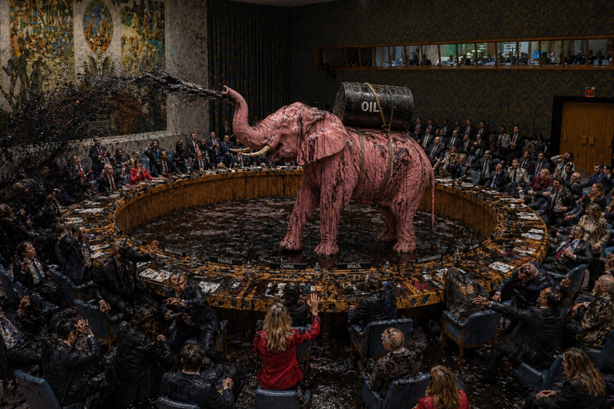
Things could get messy if not managed well..
Sources:
[1] Centre for International Environmental Law: https://www.ciel.org/issue/fossil-fuels/
[2] Coincidentally it was at COP28, presided over by a fossil fuel company executive when the United Arab Emirates hosted the meeting.
[3] International Energy Agency, Tracking the impact of government support: Fossil Fuel Subsidies, 2022 figures: https://ataglink.org/3Y6nret
[4] International Monetary Fund, Climate Change | Fossil Fuel Subsidies, 2022 figures: https://ataglink.org/4pnArII
[6] https://apnews.com/article/colombia-truckers-protest-fuel-subsidies-ef0b6e13829b1e6f6e006e95509a2c9e
[7] https://en.wikipedia.org/wiki/Yellow_vests_protests
[8] https://www.wri.org/insights/4-charts-explain-greenhouse-gas-emissions-countries-and-sector